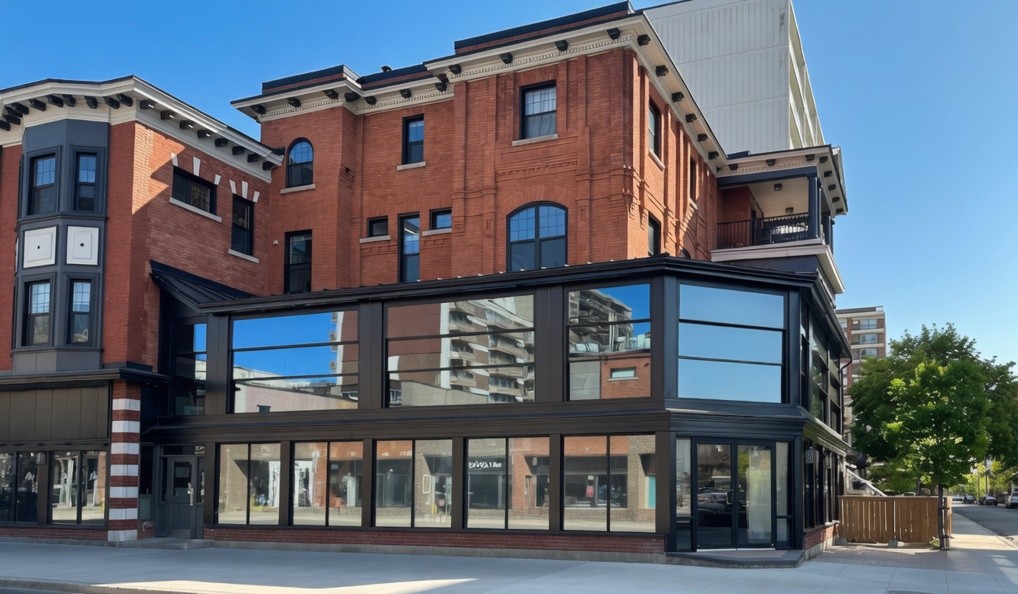


Retail plazas are designed around variety. A single Ottawa commercial property may contain a restaurant, pharmacy, coffee shop, salon, medical clinic, grocery store, professional office, fitness studio, and several specialty retailers.
Each tenant operates independently, but customers experience the plaza as one property.
That creates an important maintenance challenge.
If some storefronts have clean, clear windows while neighbouring units have visible fingerprints, road film, salt residue, or months of accumulated dirt, the property can look inconsistent. Individual tenants may arrange occasional cleaning, but without coordination, there may be no reliable standard across the entire plaza.
A coordinated commercial window cleaning plan gives Ottawa property managers, building owners, and tenants a more organized approach. Instead of waiting for individual storefronts to become noticeably dirty, window maintenance can be planned around the property’s layout, tenant traffic, seasonal conditions, and different levels of exposure.
The result is not necessarily identical cleaning for every tenant. The goal is a consistent property standard supported by a flexible maintenance plan.
Customers See the Plaza Before They See Individual Businesses
When customers arrive at a retail plaza, they do not immediately separate the property into individual leases and tenant responsibilities.
They see the overall environment.
That includes:
- Storefront windows
- Entrance doors
- Tenant signage
- Parking areas
- Walkways
- Landscaping
- Building façades
- Common areas
The condition of one storefront can influence how the surrounding property appears.
Coordinated window cleaning helps property managers maintain a more consistent exterior across multiple units.
Individual Tenant Cleaning Can Create an Uneven Appearance
Without a property-wide plan, every business may handle its windows differently.
One retailer may arrange professional cleaning regularly.
The neighbouring business may clean only when the glass becomes noticeably dirty.
Another tenant may focus almost entirely on the interior.
This can create obvious differences from one storefront to the next.
From the customer’s perspective, however, all those windows belong to the same commercial destination.
A coordinated program helps reduce those inconsistencies.
Consistency Does Not Mean Every Tenant Needs the Same Frequency
Coordinated maintenance should not be confused with identical maintenance.
A busy coffee shop may have customers entering throughout the day, creating frequent fingerprints on its doors.
A professional office in the same plaza may receive relatively few visitors.
A restaurant may have large windows facing a busy parking area.
Another tenant may have a recessed storefront protected from road spray and weather.
Putting every piece of glass on exactly the same schedule can therefore be inefficient.
A better plan establishes a property-wide standard while allowing service frequency to vary where necessary.
Start by Understanding the Plaza’s Glass
Before establishing a maintenance schedule, it helps to understand what is actually being maintained.
A retail plaza may include:
- Individual storefront windows
- Tenant entrance doors
- Shared entrance doors
- Vestibules
- Interior common-area glass
- Second-floor office windows
- Corner-unit windows
- Side-facing glass
- Rear office windows
- Glass surrounding signage
Some areas are highly visible to customers. Others receive significantly less exposure.
Mapping these different areas makes it easier to build a practical plan.
Main Storefronts Should Usually Be a Priority
The front elevation is typically the most visible portion of a retail plaza.
Customers see it while:
- Driving into the property
- Parking
- Walking toward businesses
- Moving between tenants
- Waiting outside
- Looking for signage
Storefront glass should therefore receive significant attention within the maintenance program.
A clean, consistent row of storefronts can help the plaza feel better maintained as a whole.
Entrance Doors May Need More Frequent Attention
Entrance doors behave differently from large storefront panes.
They are touched constantly.
Fingerprints and hand marks may appear around handles shortly after cleaning, particularly at high-traffic businesses.
Rather than increasing the cleaning frequency of every window, a coordinated plan can identify high-touch entrances and give them additional attention.
This is particularly useful for tenants such as:
- Grocery stores
- Pharmacies
- Coffee shops
- Restaurants
- Fitness studios
- Medical clinics
- Busy retailers
The exact frequency should depend on actual customer traffic.
Different Tenant Types Create Different Maintenance Demands
One of the challenges of managing a retail plaza is that neighbouring businesses can operate very differently.
A salon may prioritize polished presentation.
A restaurant may have large dining-room windows.
A pharmacy may have constant entrance traffic.
A professional office may receive visitors primarily by appointment.
A fitness studio may experience concentrated traffic before and after classes.
The property-wide window cleaning plan should recognize these differences rather than forcing every tenant into one maintenance pattern.
Restaurants Can Have Large, Highly Visible Windows
Restaurants often use their windows to showcase atmosphere.
Customers walking through the plaza may see:
- Dining areas
- Interior lighting
- Décor
- Seating
- Activity inside
Large panes can therefore contribute significantly to the restaurant’s exterior presentation.
They may also face parking areas, pedestrian walkways, or patios that increase environmental exposure.
These windows may justify different maintenance priorities from neighbouring office units.
Coffee Shops Can Experience Constant Door Traffic
Coffee shops may have frequent customer turnover from early morning onward.
Even if the main windows remain relatively clean, the entrance can accumulate fingerprints quickly.
Window seating can also make interior glass more noticeable because customers sit directly beside it.
A coordinated plaza plan can allow these high-touch areas to receive additional attention without changing the schedule for every tenant.
Pharmacies May Receive Customers Throughout the Day
Pharmacies often experience consistent customer traffic rather than one short rush.
Glass entrance doors can therefore develop fingerprints repeatedly.
During Ottawa winters, lower sections may also collect salt and dirty moisture from nearby sidewalks and parking areas.
A coordinated program can identify pharmacy entrances as higher-priority glass while keeping the overall plaza schedule efficient.
Salons and Spas Often Depend on Presentation
Beauty and wellness businesses usually put substantial effort into atmosphere and visual presentation.
Their storefront introduces customers to that experience.
Clear windows can support interior visibility, branding, product displays, and natural light.
For these tenants, visibly dirty glass can stand out against an otherwise polished storefront.
Medical Clinics and Professional Offices Have Different Traffic Patterns
A clinic may receive patients throughout the day, while an accounting office or other professional firm may have lower pedestrian traffic.
Both benefit from professional property presentation, but their glass may accumulate marks at different rates.
The coordinated plan should respond to these differences rather than assuming all tenants require the same frequency.
Fitness Studios Can Have Concentrated Traffic Peaks
Gyms and boutique fitness studios may experience large groups entering shortly before classes and leaving shortly afterward.
That can create periods of intense entrance activity.
Large front windows may also be part of the studio’s street presence.
These patterns should be considered when determining which plaza entrances need more frequent maintenance.
Corner Units Can Have More Glass to Maintain
Corner tenants frequently have windows on two sides of the building.
This gives them excellent visibility but creates additional maintenance requirements.
One elevation may face the parking lot while another faces a busy road or pedestrian route.
The two sides can even develop buildup at different rates.
A coordinated plan should account for both the quantity and exposure of the glass rather than treating every commercial unit equally.
Parking Lots Can Have a Major Effect on Plaza Windows
Many Ottawa retail plazas are surrounded by substantial parking areas.
Vehicle activity can influence storefront glass throughout the year.
During dry weather, traffic can contribute to dust.
During rainy periods, lower surfaces may receive splash.
Winter introduces salt, sand, slush, and dirty meltwater.
Storefronts positioned close to driving lanes may therefore become dirty faster than more protected units.
Snow Clearing Can Change Which Storefronts Receive the Most Exposure
Winter property maintenance can create changing conditions around a plaza.
Snow may be piled in particular areas.
Plows move snow, sand, and salt through parking lanes.
As temperatures fluctuate, snowbanks can produce dirty meltwater.
Storefronts near these areas may experience more lower-level residue than businesses elsewhere in the property.
A coordinated plan allows property managers to respond to these differences.
Ottawa Winter Requires More Than a Once-a-Season Approach
Winter conditions can affect retail plazas for months.
Waiting until spring to address storefront glass may allow salt film and road residue to remain visible for much of the season.
Instead, property managers can monitor vulnerable areas and adjust maintenance as conditions require.
This does not mean every plaza needs constant full-window service throughout winter.
High-exposure areas can simply receive more attention when needed.
Lower Glass Can Become Dirty Before Upper Windows
Ground-level retail glass is especially vulnerable to winter buildup.
The bottom sections of storefronts may develop visible salt and splash while upper portions remain relatively clear.
Recognizing this difference helps property managers avoid an all-or-nothing approach.
Priority cleaning can focus on the areas experiencing the most obvious buildup.
Spring Cleaning Can Reset the Entire Plaza
Spring provides an important opportunity for a property-wide exterior refresh.
After winter, windows may carry:
- Salt residue
- Road film
- Sand
- Dried moisture
- General grime
Coordinating a spring window cleaning across tenants can help restore consistency to the plaza rather than having individual storefronts cleaned weeks or months apart.
It can also complement other seasonal property work such as landscaping, parking-area cleanup, and signage maintenance.
Construction Season Can Disrupt Normal Cleaning Schedules
Roadwork and nearby development can increase dust dramatically.
A plaza that normally maintains its windows successfully on one schedule may suddenly experience faster buildup.
Rather than permanently increasing service frequency, property managers can temporarily adjust the plan during construction.
Once the source of additional dust disappears, the normal schedule can resume.
Summer Can Increase Customer Visibility
Warmer weather can bring greater pedestrian activity around restaurants, cafés, retailers, fitness businesses, and other commercial tenants.
Patios may open.
Customers may walk between businesses rather than moving directly from their cars to one unit.
This means people can spend more time viewing storefronts at close range.
Maintaining consistent windows can help the plaza present itself well during these busier outdoor periods.
Patio Businesses Can Increase Attention on Nearby Glass
Restaurants and cafés with patios create additional activity around the building exterior.
Customers may sit beside storefront windows for extended periods.
That makes dirt and streaks easier to notice than when people simply walk past.
Property managers can identify patio-facing glass as a seasonal priority where appropriate.
Fall Maintenance Helps Prepare the Plaza for Winter
Fall is an opportunity to remove summer dust, construction residue, pollen, and rain spotting before colder weather arrives.
It can also be used to evaluate the winter plan.
Managers can identify:
- High-exposure storefronts
- Parking-facing glass
- Areas near snow storage
- Frequently used entrances
- Shared vestibules
This preparation makes it easier to prioritize service once winter conditions begin.
Coordinated Cleaning Can Simplify Property Management
Without a coordinated plan, window maintenance can become fragmented.
A property manager may receive separate requests from tenants at different times.
One business complains about dirty windows.
Another schedules its own provider.
A third assumes window cleaning is handled by property management.
The result can be confusion and inconsistent service.
A defined maintenance program establishes clearer expectations.
A Regular Schedule Can Reduce Last-Minute Service Requests
Reactive maintenance creates administrative work.
Someone must notice the problem, contact a service provider, arrange access, coordinate with tenants, and confirm completion.
Recurring service can reduce this cycle.
The property manager can establish a baseline schedule and make adjustments only when unusual conditions require them.
That can make maintenance more predictable across a multi-tenant property.
Centralized Scheduling Can Reduce Disruption
Coordinating service across multiple storefronts can also reduce repeated visits.
Rather than having cleaning arranged separately for several tenants, work can potentially be organized around the property as a whole.
This can make it easier to coordinate:
- Access
- Parking
- Service timing
- Tenant communication
- Common areas
The exact approach will depend on the plaza layout and tenant agreements.
Tenants Should Understand What the Plan Covers
Clear communication is important.
Tenants should know which glass areas are included in property-managed service and which remain their responsibility.
Questions may include:
- Are exterior storefront windows included?
- Are entrance doors included?
- Is interior glass included?
- Are shared vestibules maintained?
- How frequently is service scheduled?
- Who handles additional cleaning requests?
Defining these expectations helps prevent gaps.
Shared Entrances Need Special Attention
Some plazas or mixed-use commercial properties have common entrances leading to several businesses.
These doors may receive substantially more traffic than any individual tenant entrance.
They should be treated as high-priority glass.
Because every visitor passes through them, their condition influences the first impression of multiple tenants at once.
Common-Area Glass Should Not Be Overlooked
Multi-tenant properties may include additional glazing around:
- Lobbies
- Hallways
- Stairwells
- Interior doors
- Shared waiting areas
These surfaces contribute to the overall customer experience.
A coordinated plan should identify them clearly so they do not fall between tenant and property-management responsibilities.
Storefront Signage and Windows Should Be Maintained Together
Retail plazas depend heavily on signage.
Customers need to identify businesses quickly while driving or walking through the property.
Tenant signs, window graphics, and storefront glass all work together.
A professionally maintained sign above visibly dirty windows can create an uneven presentation.
Coordinating signage services with window maintenance can help keep the overall storefront system looking more consistent.
Window Graphics Need Clean Surrounding Glass
Businesses may use windows for:
- Logos
- Promotional graphics
- Store hours
- Sale announcements
- Service information
- Seasonal campaigns
Even when graphics themselves remain in good condition, surrounding glass can accumulate dirt.
Regular cleaning helps ensure customers focus on the message rather than environmental buildup.
Promotional Periods Can Affect the Entire Plaza
Retail properties may host:
- Holiday promotions
- Sidewalk sales
- Seasonal events
- Grand openings
- Community activities
- Tenant celebrations
These events can increase both customer traffic and attention on storefronts.
A coordinated cleaning before a major property-wide event can help ensure one neglected unit does not visually stand out from otherwise prepared storefronts.
Vacant Units Should Not Be Forgotten
One frequently overlooked part of retail-plaza maintenance is vacant storefronts.
A unit without a tenant may no longer have staff monitoring its windows.
As a result, dust and grime can accumulate while neighbouring businesses remain maintained.
Customers still see that vacant glass as part of the property.
Keeping it reasonably clean can help the plaza avoid a neglected appearance and can also support future leasing efforts.
Clean Vacant Storefronts Can Help With Property Tours
Prospective tenants may visit available units.
The condition of the storefront becomes part of their first impression.
Clean windows allow more natural light into the vacant space and can make it easier to see the unit from outside.
Window maintenance can therefore support the presentation of available commercial space.
New Tenant Openings Need Additional Coordination
When a new business moves into a plaza, renovations can generate dust and debris.
New signage may also be installed.
Before the grand opening, the property manager and tenant can coordinate final window cleaning so construction residue does not remain on the storefront.
After opening, the new unit can be incorporated into the regular maintenance plan.
High-Traffic Tenants Can Receive Additional Service
A coordinated program does not need to ignore individual tenant requirements.
If one business consistently develops dirty entrance glass faster than neighbouring units, additional service can be assigned to that specific area.
This creates a flexible system where the plaza maintains a common standard without unnecessary cleaning elsewhere.
A Tiered Cleaning Plan Can Work Well for Retail Plazas
Instead of assigning one frequency to every pane, property managers can group glass by priority.
Tier 1: High-Touch Glass
Shared entrances, busy tenant doors, vestibules, and other frequently touched surfaces.
Tier 2: Main Storefront Glass
Customer-facing windows across the primary plaza elevation.
Tier 3: High-Exposure Glass
Windows near busy roads, parking lanes, snow storage, construction, or patios.
Tier 4: Lower-Priority Glass
Protected side or rear windows and other less visible areas.
The exact categories can be adjusted for the property.
Property Inspections Can Help Fine-Tune the Schedule
Maintenance programs work best when they respond to actual conditions.
Property managers can include windows in routine site inspections.
Useful observations include:
- Fingerprints on doors
- Salt on lower panes
- Road film
- Construction dust
- Water spotting
- Uneven appearance between tenants
Over time, these observations show whether cleaning intervals need adjustment.
Avoid Cleaning Too Frequently Without a Reason
Coordinated maintenance does not mean maximizing the number of cleaning visits.
The objective is to maintain the property efficiently.
If a protected section of glass remains presentable for a longer period, there may be no reason to clean it simply because a high-traffic entrance needs attention.
Customized intervals allow property managers to focus resources where they are actually needed.
Avoid Waiting Until the Entire Plaza Looks Dirty
The opposite approach creates another problem.
Waiting until every storefront is visibly dirty means the highest-exposure areas may have looked neglected for weeks.
A better plan maintains a baseline standard and responds to areas that develop buildup faster.
This balance is especially useful for large commercial properties.
Multi-Property Managers Can Standardize Their Approach
Property management companies responsible for several Ottawa retail plazas can extend the same principle across their portfolio.
Each plaza may have:
- Different tenants
- Different traffic levels
- Different road exposure
- Different amounts of glass
- Different parking layouts
The exact service schedule can vary, but the inspection and maintenance standard can remain consistent.
This makes it easier to manage multiple properties without forcing them into identical schedules.
Recurring Window Cleaning Can Support Budget Planning
Unexpected maintenance requests can make commercial property expenses less predictable.
A recurring plan establishes a clearer baseline for window cleaning.
Temporary increases can still be made when construction, weather, tenant openings, or special events create unusual requirements.
For property managers, this combination of routine scheduling and flexibility can be easier to manage than purely reactive service.
How Often Should an Ottawa Retail Plaza Schedule Window Cleaning?
There is no universal schedule for every plaza.
Frequency depends on factors such as:
- Number of tenants
- Customer traffic
- Amount of storefront glass
- Road proximity
- Parking-lot activity
- Tenant mix
- Shared entrances
- Nearby construction
- Seasonal weather
- Patio activity
- Property presentation standards
High-touch doors may require attention more frequently than full storefront windows.
Protected secondary windows may require less frequent service.
The appropriate plan should be based on actual property conditions.
Signs a Retail Plaza’s Current Plan Needs Adjustment
Property managers may want to review the schedule when:
- Some tenants consistently look dirtier than others
- Entrance doors become heavily marked between services
- Winter salt accumulates on lower windows
- Vacant units appear neglected
- Road-facing storefronts develop visible film
- Construction creates additional dust
- Tenants frequently request unscheduled cleaning
- Major seasonal promotions require repeated last-minute service
- Common-area glass is being overlooked
These patterns can indicate that a more coordinated or flexible approach is needed.
The Goal Is a Consistent Property Standard
A successful retail-plaza window cleaning program is not about making every tenant identical.
Businesses have different customers, operating hours, storefront designs, and maintenance needs.
The goal is to prevent those differences from creating an inconsistent or neglected property appearance.
Coordinated maintenance gives property managers a framework for deciding what needs attention, when it should be cleaned, and which areas deserve additional service.
Build a More Organized Window Cleaning Plan for Your Ottawa Retail Plaza
Managing a multi-tenant commercial property already involves landscaping, parking areas, snow removal, signage, building maintenance, tenant communication, and many other responsibilities.
Window cleaning should not need to become another recurring last-minute problem.
Ottawa Window Cleaning provides commercial window cleaning and recurring maintenance for retail plazas, shopping centres, multi-tenant properties, property managers, storefront businesses, professional buildings, and other commercial properties throughout Ottawa.
A coordinated plan can be customized around the number of tenants, storefront configuration, parking-lot exposure, customer traffic, shared entrances, seasonal weather, construction activity, and individual high-priority areas.
Learn more about Commercial Window Cleaning:
Explore Window Cleaning Maintenance:
Learn more about Signage Services:
Request a free estimate:
Or call 613-327-8828.
Frequently Asked Questions
Should every tenant in an Ottawa retail plaza have windows cleaned at the same frequency?
Not necessarily. A coordinated plan can establish a consistent property standard while allowing high-traffic or high-exposure storefronts to receive more frequent attention.
Who should coordinate window cleaning at a multi-tenant property?
That depends on lease arrangements and property responsibilities. When exterior maintenance is managed centrally, the property manager can coordinate recurring service and communicate clearly with tenants about what is included.
Should entrance doors be cleaned more frequently than storefront windows?
They may need to be. Entrance doors receive frequent customer contact, so fingerprints and smudges can appear much faster than environmental buildup on larger storefront panes.
How does Ottawa winter affect retail-plaza windows?
Salt, sand, slush, dirty meltwater, snow clearing, and parking-lot activity can create significant buildup on ground-level glass. Some storefronts may be more affected depending on their position within the plaza.
Should vacant retail units still have their windows cleaned?
Yes, they can be included in the property maintenance plan. Vacant storefronts remain visible to customers and prospective tenants, so allowing them to become noticeably neglected can affect the overall presentation of the plaza.
Can a cleaning plan be adjusted during nearby construction?
Yes. Roadwork or building construction can temporarily increase dust. Service frequency can be increased for affected storefronts while work is active and reduced again when conditions return to normal.
Can Ottawa Window Cleaning coordinate service across multiple plazas?
A recurring commercial window cleaning program can be structured around multiple properties, with individual schedules adjusted according to each plaza’s tenant mix, traffic, exposure, glass configuration, and seasonal maintenance needs.