

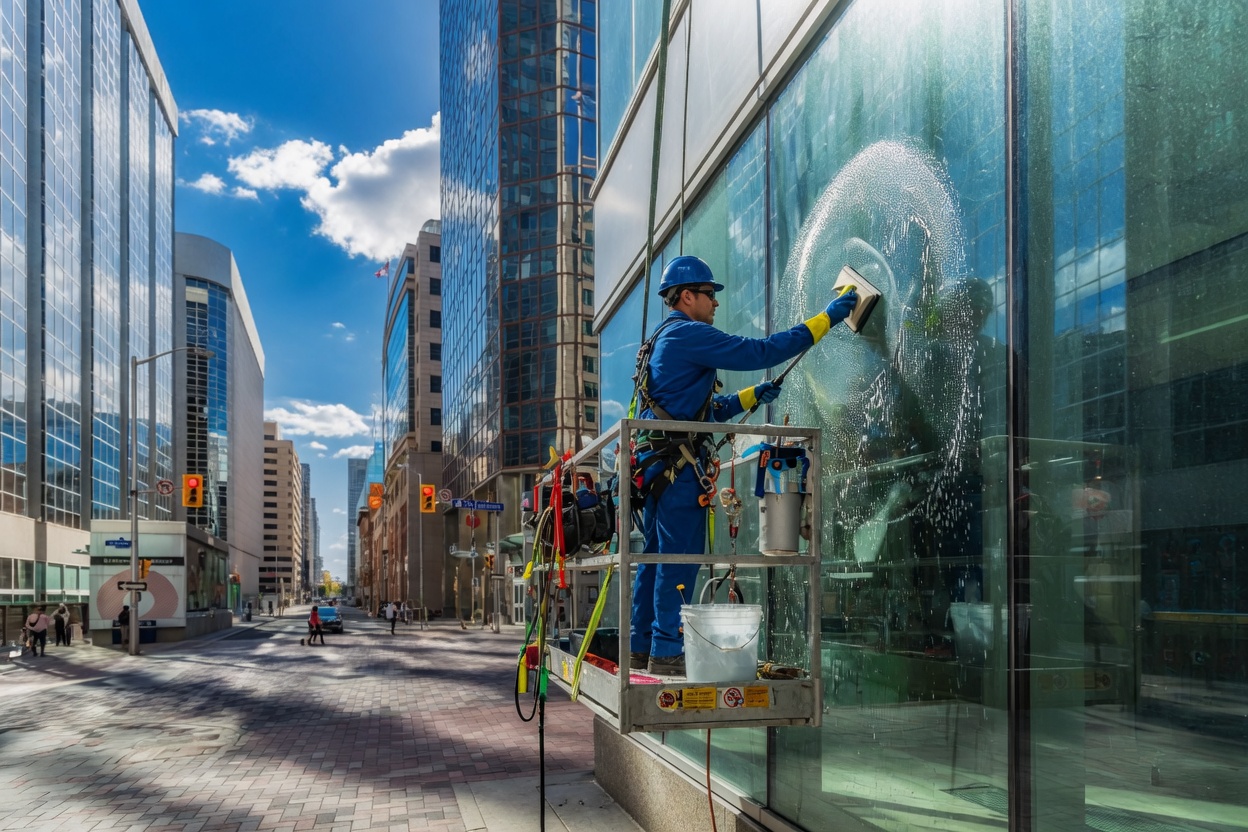
Entrance glass is one of the hardest parts of a commercial property to keep looking clean.
Unlike upper-level windows or less accessible exterior glass, entrance doors are touched throughout the day. Customers reach for handles, employees come and go, delivery drivers carry packages through the doorway, and changing Ottawa weather brings moisture, salt, slush, dust, and other residue directly toward the entrance.
During particularly busy periods, a glass door that looked spotless in the morning can develop fingerprints and visible marks surprisingly quickly.
For retailers, restaurants, cafés, salons, medical offices, professional firms, grocery stores, service businesses, and other Ottawa commercial properties, the solution is not simply cleaning every window more often. A better approach is to recognize entrance glass as a high-touch area and give it a maintenance schedule that reflects its actual use.
With regular commercial window cleaning, appropriate between-service care, and seasonal adjustments, Ottawa businesses can keep their entrances looking more consistently professional even when customer traffic increases.
Why Entrance Glass Gets Dirty Faster Than Other Windows
Commercial windows and entrance doors may be part of the same façade, but they experience very different conditions.
A large storefront pane may go untouched for days or weeks.
An entrance door can be touched hundreds of times during the same period.
Common sources of marks include:
- Fingerprints
- Handprints
- Moisture
- Road residue
- Dust
- Salt
- Slush
- Rain splash
- Delivery activity
- General pedestrian traffic
Because customers approach entrance glass from very close range, even relatively small marks can become noticeable.
This makes entrances a logical priority within a commercial window maintenance program.
High-Traffic Seasons Are Different for Every Business
There is no single “busy season” that applies to every Ottawa company.
A retailer may experience its highest traffic during holiday shopping periods.
A restaurant may become busier during patio season or local events.
An auto service centre may experience seasonal tire-change traffic.
A bakery may become particularly busy around holidays.
A salon may have increased appointments before major celebrations.
A professional office may have less seasonal variation but still experience periods with more meetings or visitors.
Window maintenance should reflect these individual patterns rather than following an inflexible calendar.
The Entrance Creates the First Close-Up Impression
Customers may see the building from across a parking lot or down the street, but the entrance is where they experience the property at close range.
They may stand directly in front of a glass door while opening it or waiting for someone else to exit.
At that distance, fingerprints and streaks become much more obvious.
This is why businesses that otherwise have clean storefront windows can still appear less polished when entrance glass is neglected.
Separate Entrance Cleaning From Full Window Cleaning
One of the most practical strategies is to stop treating all commercial glass as one maintenance category.
The entire building may not need another complete window cleaning simply because the entrance doors have accumulated fingerprints.
Instead, businesses can divide glass into maintenance priorities.
High-touch glass may include entrance doors, vestibules, and interior customer doors.
High-visibility glass may include main storefront windows and lobby glazing.
Lower-exposure glass may include protected side windows or other less visible areas.
Each category can follow an appropriate cleaning interval.
High-Touch Glass May Need More Frequent Attention
For a busy customer-facing business, entrance glass can require attention between complete professional window cleaning services.
This is particularly true during periods of unusually high customer volume.
Rather than allowing fingerprints to accumulate until the next full service, businesses can monitor the entrance and address high-touch areas as needed.
This helps maintain a more consistent appearance without unnecessarily increasing service for every window.
Identify the Most Frequently Touched Areas
Fingerprints are rarely distributed evenly across an entire glass door.
They tend to cluster around predictable areas.
These can include:
- Door handles
- Push areas
- The glass beside handles
- Lower sections touched by children
- Interior vestibule doors
- Accessible entrance controls
Observing these patterns helps businesses focus routine attention where it is most useful.
Automatic Doors Still Accumulate Marks
Automatic doors can reduce direct hand contact, but they do not eliminate maintenance requirements.
Customers may still touch the glass while:
- Waiting for doors to open
- Moving through with bags
- Guiding children
- Entering with carts
- Holding the door for someone
- Navigating a busy entrance
Exterior conditions also affect automatic doors regardless of how often customers physically touch them.
Lower glass may collect splash, salt, road film, and moisture.
Vestibules Can Double the Amount of High-Touch Glass
Many Ottawa commercial properties have vestibules to help manage winter weather and indoor temperatures.
These spaces often contain two sets of glass doors.
That creates additional surfaces customers interact with.
The exterior doors may receive the most weather exposure, while interior vestibule doors can accumulate fingerprints and smudges.
Businesses should inspect both sets rather than focusing only on the outer entrance.
Ottawa Winter Creates the Toughest Entrance Conditions
Winter introduces a combination of challenges that can quickly change the appearance of ground-level commercial glass.
Customers and employees arrive from sidewalks and parking areas affected by snow and road maintenance.
Entrances may encounter:
- Salt residue
- Slush
- Sand
- Snow spray
- Dirty meltwater
- Moisture
The lower sections of glass doors and adjacent panels can become particularly affected.
A cleaning schedule that works during summer may therefore be insufficient during winter.
Salt Residue Can Be Particularly Noticeable
Winter salt often leaves a pale film after moisture dries.
On dark days it may be relatively subtle.
Under strong interior lighting or sunlight, it can become much more noticeable.
Businesses near busy roads, parking lots, or heavily treated sidewalks may experience faster salt accumulation than more protected properties.
This is why cleaning frequency should reflect actual exposure.
Snowbanks Can Change Storefront Conditions
Snow removal can alter how moisture and road residue move around a commercial property.
Large snowbanks near parking areas or entrances can produce dirty meltwater during warmer periods.
Passing vehicles can also create splash.
If these conditions repeatedly affect the same lower glass panels, those areas may need additional attention during winter.
Spring Brings a Different Type of Buildup
When winter ends, businesses may still have substantial residue around entrances.
Spring can reveal accumulated:
- Salt
- Sand
- Road film
- Dried splash
- General winter grime
A thorough spring window cleaning can help reset the storefront.
But spring also introduces rain, pollen, mud, and construction activity, so businesses should continue monitoring entrances rather than assuming the seasonal cleaning will last indefinitely.
Summer Can Bring More Pedestrian Traffic
For many Ottawa businesses, warmer weather means more people walking through commercial neighbourhoods.
Restaurants may open patios.
Retail areas can become busier.
People may spend more time visiting local shops, cafés, and services.
This can increase entrance traffic even though winter residue is no longer a major concern.
During summer, fingerprints and dust may replace salt and slush as the primary maintenance issues.
Construction Can Make Entrance Glass Dirty Faster
Ottawa roadwork and building construction can create substantial dust during warmer months.
Businesses located close to active work may notice fine particles settling on exterior glass.
Customers then interact with doors already coated with dust, potentially creating more visible marks around handles and push areas.
If construction temporarily increases buildup, businesses can adjust cleaning frequency until the work is complete.
There is no need to permanently change the schedule when the environmental condition itself is temporary.
Fall Is a Good Time to Reassess the Maintenance Plan
Fall provides an opportunity to prepare for winter.
Businesses can evaluate how well their summer schedule worked and determine whether entrances will require more frequent attention once snow and road salt return.
A professional fall cleaning can also remove summer dust, rain spotting, and other buildup before winter conditions begin.
Retail Stores Can Experience Major Seasonal Traffic Changes
Retail entrances may become particularly busy around:
- Holiday shopping
- Seasonal sales
- Product launches
- Promotional events
- Back-to-school periods
- Special shopping days
During these periods, entrance glass can accumulate fingerprints much faster than usual.
Businesses can temporarily increase attention to high-touch areas without necessarily changing the long-term maintenance schedule.
Restaurants and Cafés May Have Different Traffic Peaks
Restaurants, bakeries, and coffee shops often experience several traffic peaks within the same day.
Morning customers, lunch crowds, afternoon visitors, and dinner traffic can create repeated entrance activity.
Weekend patterns may differ again.
Businesses with consistently busy doors should evaluate entrance glass independently from less frequently touched storefront windows.
Grocery Stores Can Have Constant Entrance Activity
Grocery and specialty food stores may experience steady traffic throughout operating hours.
Customers may also move carts, baskets, bags, and umbrellas through entrances.
Automatic doors can reduce direct contact, but surrounding glass may still become marked.
During winter, carts and footwear can also bring substantial moisture and residue close to lower glass.
For these businesses, entrance maintenance may need to be one of the highest priorities.
Pharmacies Can Experience Traffic Throughout the Day
Pharmacies often receive a steady stream of customers rather than one short rush.
Visitors may arrive for prescriptions, health products, consultations, or everyday purchases.
Because customers continually interact with the entrance, fingerprints can return quickly.
A maintenance plan that prioritizes entrance doors can help keep the customer-facing exterior more consistent throughout the week.
Salons and Spas Benefit From a Polished Entrance
Beauty and wellness businesses often place significant emphasis on atmosphere and presentation.
The entrance introduces customers to that experience.
Fingerprints on a glass door can stand out against an otherwise carefully designed storefront.
High-touch entrance maintenance can therefore complement the polished interior environment these businesses work to create.
Medical and Professional Offices Should Consider Visitor Experience
Professional properties may not experience retail-level traffic, but their visitors can still notice entrance glass.
Medical clinics, financial offices, real estate businesses, law firms, and other professional organizations may receive clients throughout the day.
Clean entrance doors help the exterior support the professional environment inside.
Busy Events Can Temporarily Change Cleaning Requirements
A business that normally has moderate traffic may suddenly host:
- A grand opening
- An anniversary celebration
- An open house
- A promotional event
- A product launch
- A customer appreciation event
Hundreds of additional visitors can pass through the entrance within a relatively short period.
Businesses should consider both pre-event and post-event glass maintenance.
Cleaning before the event creates a strong starting point, while inspecting the entrance afterward helps determine whether additional attention is needed.
Holiday Promotions Can Require Extra Monitoring
Holiday periods can combine increased customer traffic with difficult Ottawa weather.
That creates two maintenance pressures at once.
More people are touching entrance doors while salt, slush, and moisture are affecting the exterior.
Businesses preparing for holiday promotions should therefore consider entrance glass separately from their normal storefront cleaning schedule.
Delivery Activity Also Affects Entrances
Customers are not the only people using commercial doors.
Businesses may receive:
- Couriers
- Food deliveries
- Inventory shipments
- Service technicians
- Suppliers
If deliveries use the main entrance, that traffic contributes to fingerprints and marks.
Large packages can also come into contact with glass.
Businesses with frequent delivery activity should include it when evaluating how heavily an entrance is used.
Employee Entrances May Need Attention Too
Some properties have separate staff entrances.
These doors may not affect customer impressions directly, but they still contribute to overall building maintenance.
For multi-tenant properties or professional offices, staff entrances can also be visible from parking areas.
A complete maintenance plan can include these areas at an appropriate frequency without necessarily giving them the same priority as the primary customer entrance.
Door Handles and Surrounding Glass Should Be Considered Together
Cleaning only the centre of a glass door can leave the highest-contact area looking neglected.
Most fingerprints accumulate around the handle.
Businesses should evaluate the entire entrance visually, including:
- Glass
- Handle area
- Adjacent panels
- Lower sections
- Sidelights
The goal is a cohesive entrance rather than one isolated clean surface.
Sidelights Can Collect Marks Too
Many commercial entrances include narrow glass panels beside the door.
These are often called sidelights.
Although they may not be touched as frequently as the door itself, they can collect dust, splash, and environmental residue.
Because they sit immediately beside the entrance, their condition affects the overall appearance.
A commercial window cleaning program should include them rather than treating only the moving door panels.
Lower Glass Needs Special Attention During Wet Weather
Rain and melting snow affect lower glass differently from upper windows.
Splash from footwear, vehicles, carts, and nearby pavement can create visible marks.
Businesses should inspect the lower portion of entrances after periods of particularly wet weather.
This can help identify areas that need additional cleaning before the rest of the storefront does.
Don’t Wait Until Customers Complain
Window maintenance should ideally happen before cleanliness becomes a customer issue.
Most customers will never mention fingerprints or dirty glass directly.
They simply experience the property.
A preventative approach avoids relying on complaints as the signal that service is needed.
Instead, businesses establish a standard and monitor whether the entrance continues to meet it.
Assign Responsibility for Between-Service Checks
A recurring professional cleaning program can provide the foundation, but high-touch glass may need simple monitoring between services.
Businesses can make entrance inspection part of normal opening or property checks.
For example, staff can quickly look for:
- Heavy fingerprints
- Obvious smudges
- Salt film
- Splash
- Unusual dirt after bad weather
This does not replace professional window cleaning.
It simply helps the business recognize when high-traffic conditions are causing faster-than-normal buildup.
Check Glass Under Different Lighting Conditions
A door can look clean from one angle and visibly streaked from another.
Sunlight, interior lighting, and evening conditions can reveal marks differently.
Businesses should occasionally inspect entrance glass from both inside and outside.
For locations operating after dark, it can also be useful to view the storefront in the evening when interior lighting shines through the glass.
Avoid Using One Frequency for the Entire Building
A common maintenance mistake is assuming the whole property should be cleaned together every time.
That can create two problems.
Either the entrance is left dirty while waiting for the next full service, or less exposed windows are cleaned more frequently than necessary simply because the doors need attention.
A tiered schedule provides a better balance.
Build a Tiered Window Cleaning Schedule
An Ottawa business could organize commercial glass into three categories.
Tier 1: High-Touch Glass
Main entrance doors, vestibules, and heavily used interior glass receive the most frequent attention.
Tier 2: High-Visibility Glass
Storefront windows, lobby glazing, and promotional windows follow a recurring schedule based on exposure.
Tier 3: Lower-Exposure Glass
Protected side windows and other less visible areas follow longer intervals when appropriate.
The exact timing depends on the property.
Use Customer Traffic to Guide Frequency
Businesses should pay attention to how many people actually use an entrance.
A door used by 30 people per day will not behave like one used by several hundred.
Traffic can also vary throughout the year.
Rather than relying exclusively on calendar intervals, businesses can combine scheduled maintenance with observation.
If fingerprints consistently become obvious well before the next service, the high-touch interval may need adjustment.
Consider Road and Parking-Lot Exposure Separately
Customer traffic explains fingerprints, but it does not explain every type of buildup.
A storefront beside a busy Ottawa road may develop exterior film even when customer traffic is moderate.
A business facing a parking lot may experience salt and vehicle splash.
These environmental factors should be considered separately when designing the cleaning schedule.
Downtown Ottawa Entrances Can Face Multiple Pressures
Downtown commercial properties can combine pedestrian traffic with road exposure, deliveries, public transit, and construction.
That can create several different sources of dirt around one entrance.
Businesses should monitor both high-touch marks and environmental residue rather than assuming one cleaning interval will address every condition equally.
The Glebe’s Pedestrian Traffic Can Make Entrance Glass Highly Visible
In pedestrian-oriented areas, customers often approach storefronts slowly and from close range.
They may stop to read signs or look through windows before entering.
This makes entrance presentation particularly visible.
Regular maintenance helps keep fingerprints and street-related buildup from distracting from displays and branding.
Westboro Businesses Can Protect Their Storefront Presentation
Retailers, cafés, salons, professional services, and other customer-facing businesses may invest heavily in attractive storefronts.
Keeping entrance glass clear helps preserve that presentation during both everyday operations and busier seasonal periods.
Centretown Businesses Should Evaluate Individual Exposure
Two businesses only a few blocks apart may have very different maintenance needs.
One may face a busy road and substantial pedestrian traffic.
Another may have a recessed entrance protected from much of the weather.
Cleaning schedules should follow actual property conditions rather than neighbourhood assumptions.
ByWard Market Businesses May Experience Heavy Pedestrian Activity
Businesses in active pedestrian environments can have people continually moving around storefronts and entrances.
Visitors may stop near the door, read menus, look through glass, or wait for others.
This makes clean entrance glass particularly valuable because it is being viewed from such close distances.
Multi-Location Businesses Need a Consistent Standard
Companies operating several Ottawa locations can establish a common entrance-cleanliness standard without forcing every property onto the same schedule.
A busy Downtown Ottawa store may require more frequent entrance attention than a protected suburban office.
The service intervals can differ while the expected presentation remains consistent.
This approach is more practical than trying to make every location identical.
Property Managers Can Prioritize Shared Entrances
Multi-tenant office and retail properties often have shared glass entrances.
These doors may experience significantly more traffic than the windows associated with any individual tenant.
Property managers can therefore place common entrances on a higher-frequency maintenance schedule while cleaning other building glass according to different intervals.
Regular Cleaning Makes Unexpected Busy Periods Easier to Handle
Businesses cannot always predict when traffic will increase.
A successful promotion, nearby event, seasonal weather change, or unexpected increase in customers can suddenly put more pressure on the entrance.
If the glass already follows a recurring maintenance program, the business starts from a better baseline.
Additional service can then be added only where necessary.
How Often Should Commercial Entrance Glass Be Cleaned?
There is no universal answer.
Businesses should consider:
- Daily customer volume
- Type of entrance
- Operating hours
- Road exposure
- Parking-lot proximity
- Delivery activity
- Seasonal weather
- Nearby construction
- Promotional events
- Desired presentation standard
Entrance glass can be maintained more frequently than the rest of the storefront when conditions justify it.
Signs Entrance Glass Needs More Frequent Attention
A business may need to adjust its maintenance plan if:
- Fingerprints become obvious shortly after cleaning
- Salt repeatedly accumulates on lower glass
- Entrance doors look noticeably dirtier than surrounding windows
- Busy periods create substantial additional marks
- Construction dust develops quickly
- Employees frequently need to address the same glass between services
- The entrance no longer matches the condition of the rest of the storefront
These patterns indicate that the current schedule may not reflect actual usage.
Consistency Matters More Than Waiting for Perfect Conditions
Commercial entrances will not remain untouched.
Customers will continue using the doors. Ottawa weather will continue changing. Deliveries will continue arriving.
The goal is not to keep every piece of glass perfectly untouched at every moment.
A practical maintenance program aims to prevent excessive buildup and maintain an appropriate professional standard over time.
That is more sustainable than waiting until entrance glass looks heavily neglected and then arranging a major cleanup.
Why Regular Commercial Window Cleaning Helps During High-Traffic Seasons
A customized window cleaning program can help Ottawa businesses:
- Keep customer entrances more consistently presentable
- Control fingerprints and high-touch marks
- Respond to winter salt and slush
- Manage seasonal traffic increases
- Adapt during promotions and events
- Address construction dust
- Maintain vestibule glass
- Support storefront presentation
- Complement signage and window displays
- Reduce reactive maintenance
- Prioritize high-traffic glass without over-cleaning the entire property
The key is matching the cleaning program to how the property is actually used.
Keep Your Ottawa Business Entrance Ready for Customers
The entrance may represent only a small portion of a commercial building’s total glass, but it is often the part customers experience most closely.
That makes it worth treating differently.
Ottawa Window Cleaning provides professional commercial window cleaning and recurring maintenance for retailers, restaurants, cafés, grocery stores, pharmacies, salons, professional offices, medical businesses, multi-tenant properties, and other commercial locations throughout Ottawa.
Cleaning programs can be customized around customer traffic, entrance configuration, road exposure, parking conditions, seasonal weather, nearby construction, and the glass areas that require the most frequent attention.
Learn more about Commercial Window Cleaning:
Explore Window Cleaning Maintenance:
Learn more about Signage Services:
Request a free estimate:
Or call 613-327-8828.
Frequently Asked Questions
Why does commercial entrance glass get dirty faster than other windows?
Entrance doors receive frequent physical contact and are exposed to customers, employees, deliveries, weather, and ground-level contaminants. Fingerprints and smudges can therefore appear much faster than dirt on less accessible windows.
Should entrance doors be cleaned more often than storefront windows?
They can be. High-touch entrance glass may benefit from a shorter maintenance interval, while larger storefront windows follow a schedule based on environmental exposure and visibility.
How does Ottawa winter affect commercial entrance glass?
Salt, sand, slush, dirty meltwater, snow spray, and moisture can accumulate around lower glass and entrance doors. Properties near roads and parking areas may experience particularly noticeable winter buildup.
Do automatic glass doors require regular cleaning?
Yes. Although automatic doors may receive less direct hand contact, customers can still touch them and exterior conditions continue affecting the glass.
Should businesses change their window cleaning schedule during busy seasons?
It can be useful to increase attention to high-touch glass during periods of heavier customer traffic. The entire building does not necessarily need more frequent cleaning.
What should businesses do before a major event or promotion?
Inspect entrance doors, vestibule glass, storefront windows, promotional displays, and other customer-facing glass. Additional cleaning can be scheduled where necessary so the property is prepared for increased traffic.
Can different entrances at the same property follow different schedules?
Yes. A heavily used customer entrance may need more frequent attention than a staff, side, or protected entrance. Cleaning frequency should reflect actual traffic and exposure.